Story of David and Goliath (Bible Lesson)
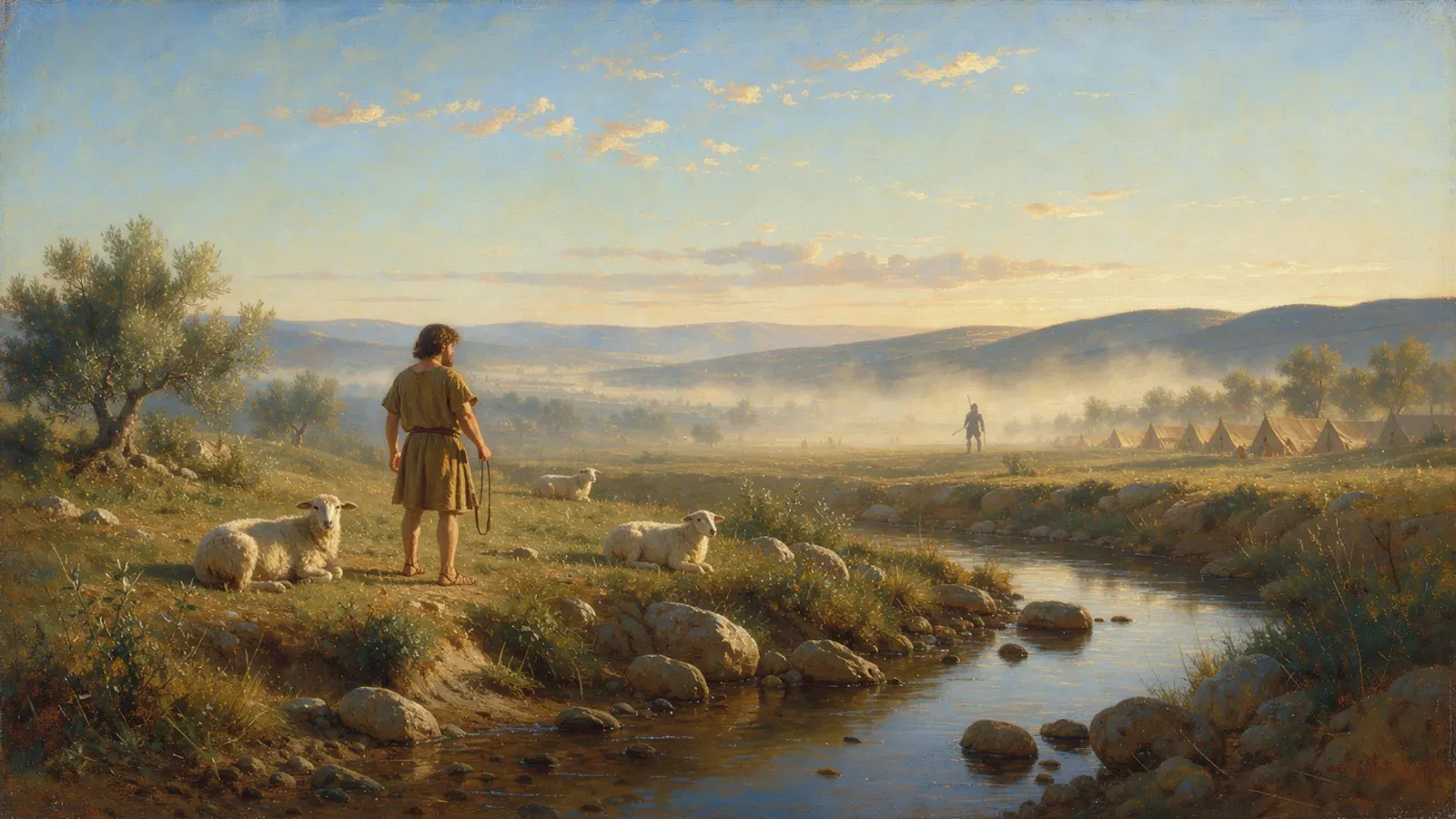
The story of David and Goliath is told in 1 Samuel 17. A young shepherd from Bethlehem faces the Philistine champion of Gath in the Valley of Elah, trusting in God rather than armor. It is read as a story of courage and faith, and many people turn to it when a challenge feels too big.
The story in 1 Samuel 16 and 17
The story begins in 1 Samuel 16. God sends the prophet Samuel to Bethlehem, to the house of Jesse, to anoint a new king in place of Saul. Samuel is drawn to the older, taller sons. The text says: “the LORD seeth not as man seeth; for man looketh on the outward appearance, but the LORD looketh on the heart” (1 Samuel 16:7). David, the youngest, is out with the sheep. He is anointed, and the Spirit of the LORD comes upon him (16:13).
In 1 Samuel 17 the Philistines and Israel face each other across the Valley of Elah, in Judah. From the Philistine camp comes a champion from Gath named Goliath. He challenges Israel to send one man to fight him, and the result will decide the war (17:8-10). Saul and all Israel are dismayed and greatly afraid. For forty days, morning and evening, the challenge is repeated (17:16).
David is not a soldier in this scene. His father Jesse sends him from the sheepfold with grain, bread and cheese for his three older brothers in Saul’s army (17:17-18). He hears Goliath’s challenge and asks what will be done for the man who defeats him. His eldest brother, Eliab, is angry with him (17:28). David persists, and he is brought to Saul.
Saul doubts that a boy can fight a seasoned warrior. David answers with what he knows: as a shepherd he has struck down a lion and a bear to protect his flock (17:34-36). He then says: “The LORD that delivered me out of the paw of the lion, and out of the paw of the bear, he will deliver me out of the hand of this Philistine” (17:37). Saul agrees to let him go.
Saul dresses David in his own armor, with a helmet of brass and a coat of mail (17:38). David says he cannot go with these, because he has not tested them (17:39). He takes his staff, chooses five smooth stones from the brook, and carries his sling (17:40). The text gives no speech about this choice. It simply shows a young man using what he knows how to use.
Goliath looks at David and despises him (17:42). David replies that he comes in the name of the LORD of hosts, and says the whole assembly will know that “the LORD saveth not with sword and spear: for the battle is the LORD’S” (17:47). He runs toward the Philistine, slings a stone, and strikes him on the forehead. Goliath falls on his face (17:49).
David cuts off Goliath’s head with the giant’s own sword (17:51). The Philistines flee, and Israel pursues them as far as Gath and Ekron (17:52). The story does not end there. Jonathan, Saul’s son, makes a covenant with David (18:1-4). But when the women sing of David’s victories, Saul grows jealous (18:6-9), and David’s years of danger begin. Christians and Jews have long read the account as a story about trust in God, though the text itself leaves much unsaid.
What the story teaches today
- Sit quietly for a minute and name the one “giant” that weighs on you today, in a single sentence.
- Recall one earlier difficulty you came through, as David recalled the lion and the bear, and give thanks for it.
- Ask which “armor” you have borrowed from others that does not suit you, and what you actually know how to do.
- Take one small, honest step toward the problem today, and do not wait for it to feel small first.
- Name a trusted friend, relative, pastor or professional who can stand with you, and consider contacting them, especially if the burden is heavy.
Prayer
Lord God, you see what I cannot see.
You look on the heart, not on the size of the problem.
When the giant in front of me seems too great,
remind me of the times you have already carried me.
Give me honesty to know my own weakness,
and the sense to ask for help from those I trust.
Teach me to be myself and not to borrow armor that does not fit.
Keep me from pride when I do well,
and from despair when I struggle.
Whatever today brings, let me walk it in your name.
Amen.
King James Version
Frequently asked questions
How tall was Goliath?
It depends on the manuscript. The Hebrew text behind the King James Version says “six cubits and a span” (1 Samuel 17:4), roughly nine feet. The Greek Septuagint and a Dead Sea Scrolls fragment of Samuel read “four cubits and a span,” closer to six and a half feet. Scholars still discuss which reading is earlier.
Did David become king right after defeating Goliath?
No. Saul remained king for years afterward, and David spent a long period fleeing from him. After Saul’s death, David was first anointed king over Judah at Hebron (2 Samuel 2:4). Later all the tribes of Israel anointed him there (2 Samuel 5:3), and he reigned forty years in total (5:4).
Does the Bible say anyone else killed Goliath?
Not directly, but one verse is debated. In the King James Version, 2 Samuel 21:19 says Elhanan slew “the brother of Goliath the Gittite,” with “the brother of” printed in italics as added words. The parallel text, 1 Chronicles 20:5, says Elhanan killed Lahmi, Goliath’s brother. Many readers see this as a copying difficulty, and others as a different Philistine.