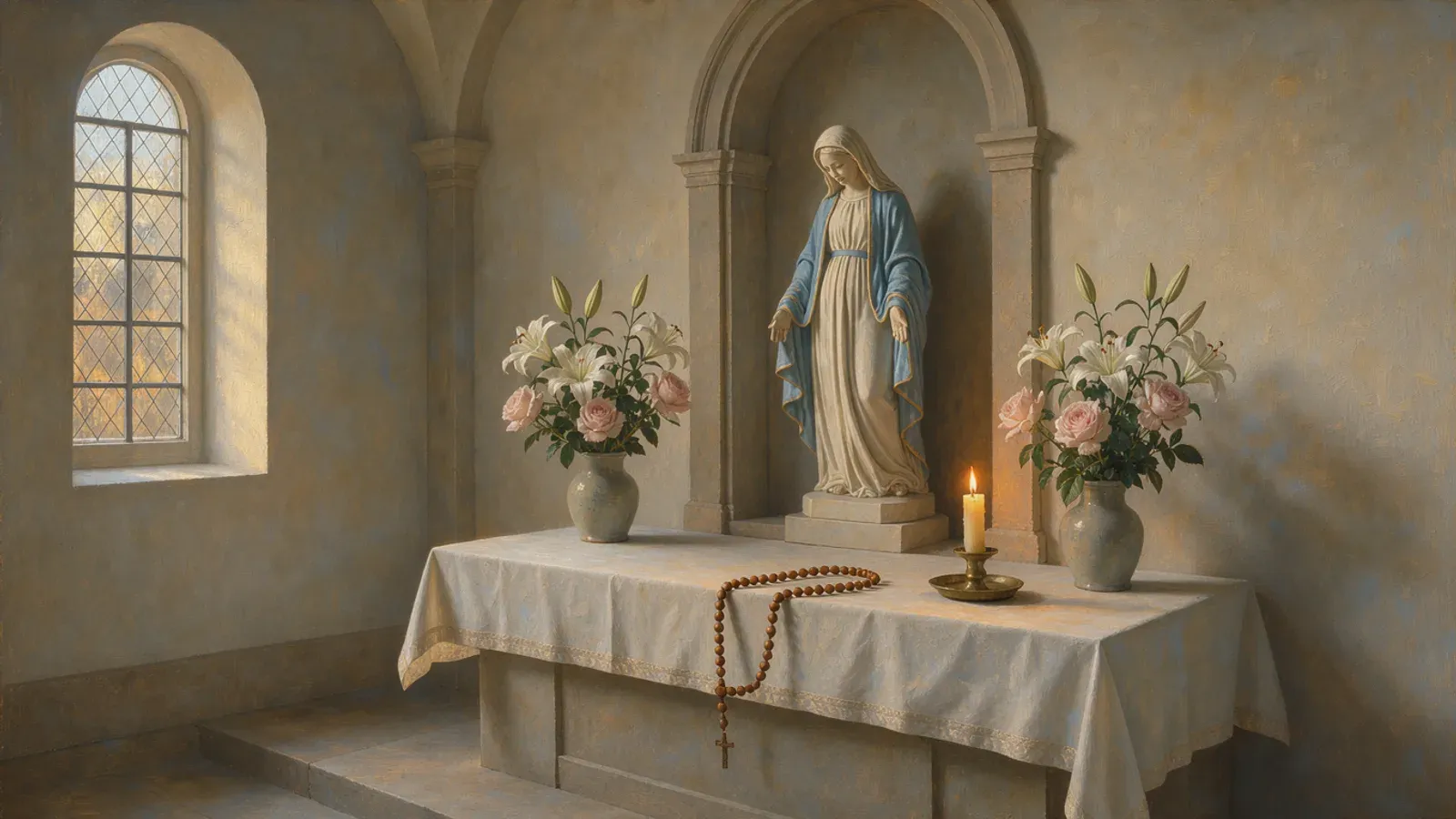
Hail Mary Prayer
The Hail Mary is the traditional Catholic prayer to the Virgin Mary. Its first part joins the angel Gabriel's greeting in Luke 1:28 with Elizabeth's in Luke 1:42, and the petition came later. Catholics pray it in the Rosary and the Angelus, and many say it in the morning, at night, or in need.
Prayer
Hail Mary, full of grace,
the Lord is with thee;
blessed art thou amongst women,
and blessed is the fruit of thy womb, Jesus.
Holy Mary, Mother of God,
pray for us sinners,
now and at the hour of our death.
Amen.
King James Version
Two greetings from Luke and a later petition
The first half of the Hail Mary is built from two greetings in Luke’s Gospel. The angel Gabriel says to Mary: “Hail, thou that art highly favoured, the Lord is with thee: blessed art thou among women” (Luke 1:28, KJV). Elizabeth then says: “Blessed art thou among women, and blessed is the fruit of thy womb” (Luke 1:42, KJV). The prayer’s “full of grace” follows the Latin of the Vulgate, gratia plena.
The second half is not in Scripture. “Mother of God” reflects the teaching of the Council of Ephesus in 431, which affirmed that Mary bore Christ, who is truly God. The petition “pray for us sinners, now and at the hour of our death” developed in the later Middle Ages. The full form we know appeared in the Roman Breviary of 1568.
In English-speaking parishes the prayer is still most often said in the traditional wording with “thee” and “thy”. It is prayed ten times in each decade of the Rosary and three times in the Angelus. Many families also say it quietly at bedtime, often for a particular person.
How to pray the Hail Mary slowly
- Sit still, breathe slowly three times, and make the Sign of the Cross.
- Say the first half slowly, pausing after “the Lord is with thee” to remember that God is near you now.
- Say the name “Jesus” as a prayer in itself, and let it rest in the silence for a moment.
- Pray the second half with one specific intention in mind, such as a person, a worry, or a decision.
- Repeat the prayer three times, in the morning or at bedtime, without hurrying.
- Close with a moment of thanks for one good thing from the day, then say Amen.
Frequently asked questions
Are there different versions of the Hail Mary?
Yes, the wording varies slightly. English speakers may say "among" or "amongst" women, or use modern "you" and "your" in place of "thee" and "thy". The Latin Ave Maria is the same prayer in the Church's historic language. Eastern Christians pray a related hymn, "Rejoice, O Virgin Theotokos", which has no petition for sinners. The meaning of the Catholic prayer stays the same.
When is the Hail Mary prayed apart from the Rosary?
The Angelus is the main other occasion. It is a devotion of three Hail Marys, traditionally prayed at 6 a.m., noon and 6 p.m., each preceded by a short verse and response about the Incarnation. During the Easter season the Regina Caeli is customarily prayed instead. Many Catholics also pray one or three Hail Marys at bedtime.
How is the Hail Holy Queen used in the Rosary?
The Hail Holy Queen is a separate prayer, not part of the Hail Mary. It is said after the final decade as a closing greeting to Mary, and a short concluding prayer usually follows. The Rosary opens with the Sign of the Cross, the Apostles' Creed, an Our Father, three Hail Marys and a Glory Be.
Prayers & Psalms
 The Lord's Prayer (Our Father)The Lord’s Prayer, also called the Our Father, is the prayer Jesus taught his disciples in Matthew 6:9-13 and Luke 11:2-4. In Matthew’s version, the one prayed today, it praises God’s name and asks for his kingdom, our daily bread, forgiveness and deliverance from evil. Catholics, Orthodox and Protestants all pray it.4 min
 Psalm 91 (Protection Prayer)Psalm 91 is a Hebrew psalm of trust that describes God as refuge, fortress and shelter. It is numbered 90 in the Latin Vulgate. Christians pray it at night, in times of fear, and before a journey. This page gives the full text in the King James Version.4 min
 Psalm 23 (The Lord is My Shepherd)Psalm 23 is a six-verse psalm attributed to David, found in the Old Testament Book of Psalms. It pictures God as a shepherd who guides, feeds and stays beside his people. Christians pray it in grief, worry or uncertainty, and in the morning or at bedtime, to rest in trust.4 min