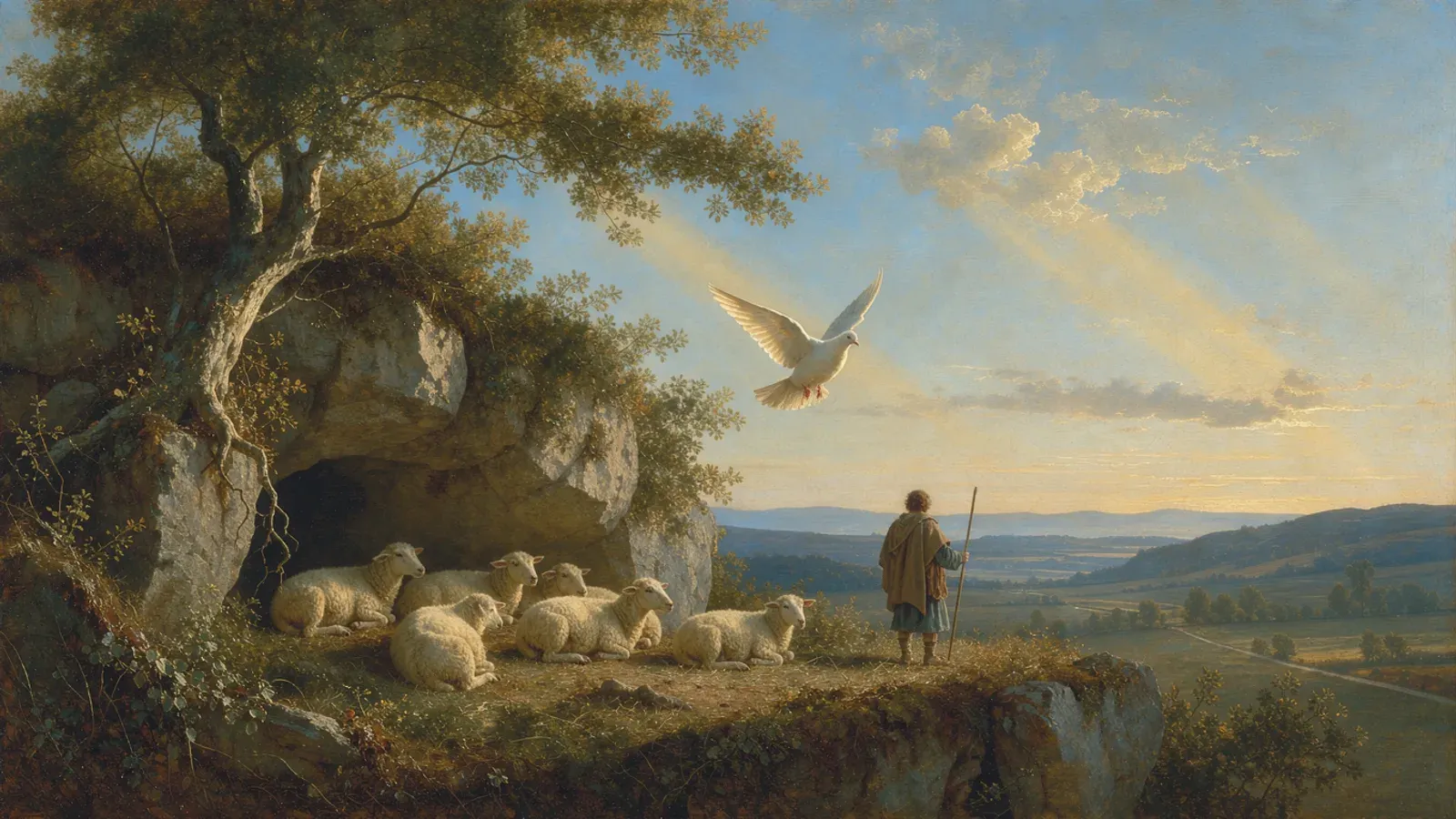
Psalm 91 (Protection Prayer)
Psalm 91 is a Hebrew psalm of trust that describes God as refuge, fortress and shelter. It is numbered 90 in the Latin Vulgate. Christians pray it at night, in times of fear, and before a journey. This page gives the full text in the King James Version.
Prayer
He that dwelleth in the secret place of the most High shall abide under the shadow of the Almighty.
I will say of the LORD, He is my refuge and my fortress: my God; in him will I trust.
Surely he shall deliver thee from the snare of the fowler, and from the noisome pestilence.
He shall cover thee with his feathers, and under his wings shalt thou trust: his truth shall be thy shield and buckler.
Thou shalt not be afraid for the terror by night; nor for the arrow that flieth by day;
Nor for the pestilence that walketh in darkness; nor for the destruction that wasteth at noonday.
A thousand shall fall at thy side, and ten thousand at thy right hand; but it shall not come nigh thee.
Only with thine eyes shalt thou behold and see the reward of the wicked.
Because thou hast made the LORD, which is my refuge, even the most High, thy habitation;
There shall no evil befall thee, neither shall any plague come nigh thy dwelling.
For he shall give his angels charge over thee, to keep thee in all thy ways.
They shall bear thee up in their hands, lest thou dash thy foot against a stone.
Thou shalt tread upon the lion and adder: the young lion and the dragon shalt thou trample under feet.
Because he hath set his love upon me, therefore will I deliver him: I will set him on high, because he hath known my name.
He shall call upon me, and I will answer him: I will be with him in trouble; I will deliver him, and honour him.
With long life will I satisfy him, and shew him my salvation.
King James Version
Who speaks in Psalm 91, and how Scripture reads it
Psalm 91 has no title in the Hebrew text, so its author and occasion are not stated. Its voice changes as it goes. Verses 1-2 are a personal confession of trust. Verses 3-13 address the believer as “thee”. In verses 14-16 God himself speaks, and the promises are given in his own voice.
The psalm uses the images of a shelter, a fortress, a bird’s wings, a shield and guardian angels. These are pictures of trust rather than a forecast of every circumstance. The same Scriptures speak of faithful people who suffered, so the psalm is read as assurance of God’s presence “in trouble” (verse 15), not of a life without trouble.
The Gospels show how the psalm should not be used. In Matthew 4:5-7 and Luke 4:9-12 the tempter quotes verses 11-12 to urge Jesus to throw himself from the temple. Jesus answers, “Thou shalt not tempt the Lord thy God” (Matthew 4:7). Trust in God’s care is not a reason to put oneself in needless danger.
How to pray Psalm 91 in the morning or at night
- Sit quietly, breathe slowly three times, and name one fear you are carrying into this moment.
- Read verses 1-2 aloud once, slowly, and let the words “my refuge and my fortress” settle before you go on.
- Read the rest of the psalm, pausing at the verse that speaks most directly to your situation.
- Read verses 14-16 as words addressed to you by God, and stay in silence for a minute.
- Say a short prayer of your own, entrusting the people and tasks of the day, or of the night, to God’s care.
- If your fear is heavy or lasts, tell a doctor, a counselor or a trusted person as well. Praying and seeking help belong together.
Frequently asked questions
Which verses of Psalm 91 can I pray when I feel very anxious?
Start with one or two verses rather than the whole psalm. Verse 2 ("in him will I trust") or verse 4 can be repeated slowly, one phrase for each breath. Longer reading can come later. If anxiety is severe or constant, prayer is not a substitute for care, so please also speak with a doctor, counselor or someone you trust.
How is Psalm 91 different from Psalm 121?
Psalm 121 is a pilgrim song, one of the Songs of Ascents (Psalms 120-134), and it centers on the LORD as keeper of a traveler, in "thy going out and thy coming in" (verse 8). Psalm 91 draws on images of shelter, wings and fortress, and ends with God speaking in his own voice. Many people pray Psalm 121 for journeys and Psalm 91 for refuge at night.
Is Psalm 91 part of the Church's night prayer?
Yes. In the Catholic Liturgy of the Hours, Psalm 91 is prayed at Compline on Sunday evening. Catholic books based on the Latin Vulgate number it Psalm 90, and it begins there with the words "Qui habitat". Anyone may pray it at bedtime on any night. Do not be confused if you find it listed as Psalm 90 in older editions.
Prayers & Psalms
 The Lord's Prayer (Our Father)The Lord’s Prayer, also called the Our Father, is the prayer Jesus taught his disciples in Matthew 6:9-13 and Luke 11:2-4. In Matthew’s version, the one prayed today, it praises God’s name and asks for his kingdom, our daily bread, forgiveness and deliverance from evil. Catholics, Orthodox and Protestants all pray it.4 min
 Hail Mary PrayerThe Hail Mary is the traditional Catholic prayer to the Virgin Mary. Its first part joins the angel Gabriel's greeting in Luke 1:28 with Elizabeth's in Luke 1:42, and the petition came later. Catholics pray it in the Rosary and the Angelus, and many say it in the morning, at night, or in need.3 min
 Psalm 23 (The Lord is My Shepherd)Psalm 23 is a six-verse psalm attributed to David, found in the Old Testament Book of Psalms. It pictures God as a shepherd who guides, feeds and stays beside his people. Christians pray it in grief, worry or uncertainty, and in the morning or at bedtime, to rest in trust.4 min