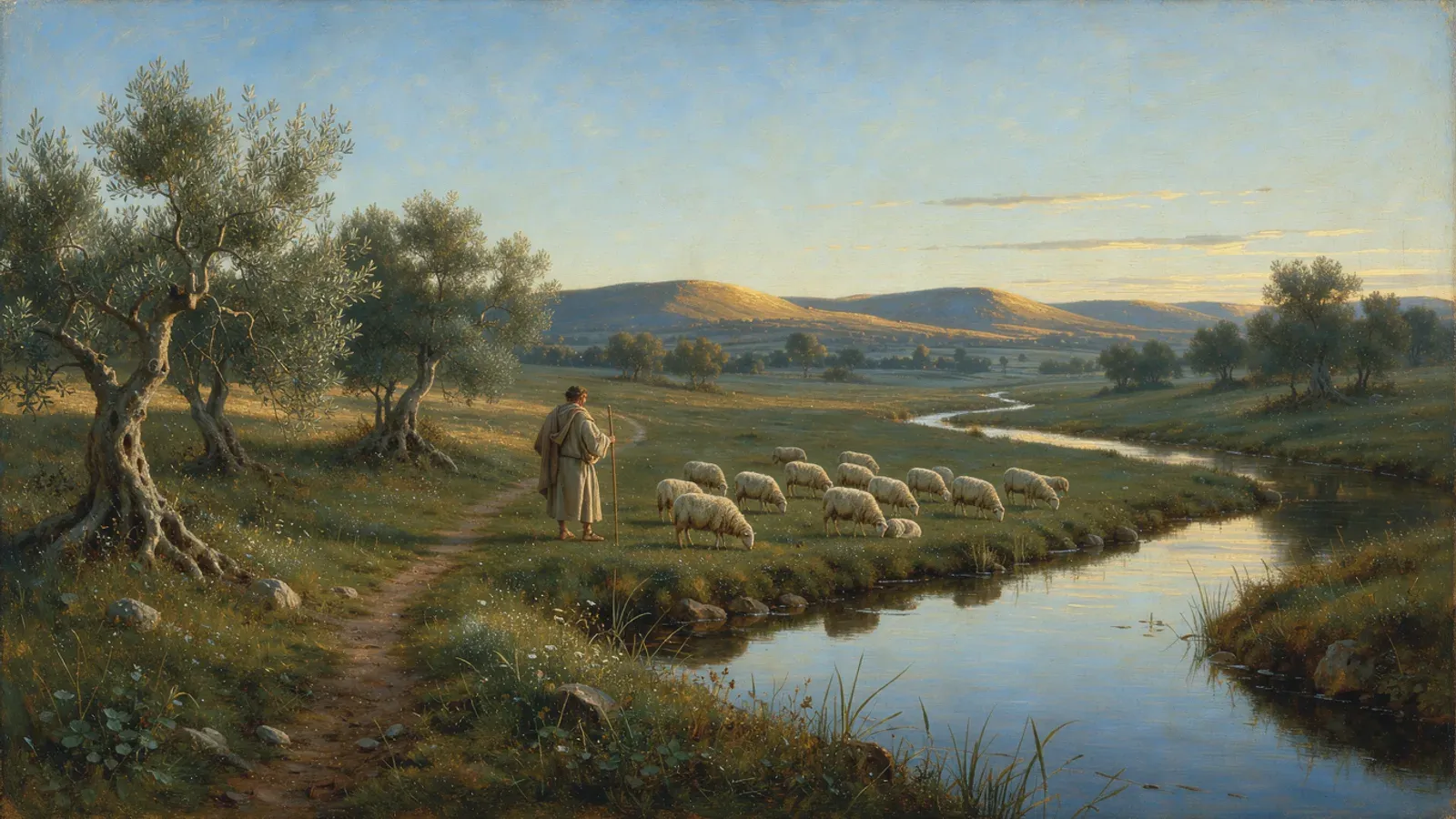
Psalm 23 (The Lord is My Shepherd)
Psalm 23 is a six-verse psalm attributed to David, found in the Old Testament Book of Psalms. It pictures God as a shepherd who guides, feeds and stays beside his people. Christians pray it in grief, worry or uncertainty, and in the morning or at bedtime, to rest in trust.
Prayer
The LORD is my shepherd; I shall not want.
He maketh me to lie down in green pastures: he leadeth me beside the still waters.
He restoreth my soul: he leadeth me in the paths of righteousness for his name's sake.
Yea, though I walk through the valley of the shadow of death, I will fear no evil: for thou art with me; thy rod and thy staff they comfort me.
Thou preparest a table before me in the presence of mine enemies: thou anointest my head with oil; my cup runneth over.
Surely goodness and mercy shall follow me all the days of my life: and I will dwell in the house of the LORD for ever.
King James Version
A shepherd’s psalm in two scenes
The heading of Psalm 23 reads “A Psalm of David.” Tradition links it to David’s own years as a shepherd, though the psalm itself does not say when it was written. The image was familiar in Israel. Elsewhere Scripture calls God the “Shepherd of Israel” (Psalm 80:1), and Jacob speaks of the God who led him through his life (Genesis 48:15).
The psalm has two scenes. In verses 1 to 4 God is the shepherd, leading to pasture and water and through dark places. In verses 5 and 6 he is the host, who sets a table and anoints the guest. Notice the change in verse 4. The psalmist stops saying “he” and says “thou art with me,” speaking to God directly at the darkest point.
In worship, the psalm is sung or read in many traditions. The Catholic lectionary uses it as the responsorial psalm on the Fourth Sunday of Easter in Year A, and it is often chosen for funerals. In English, the Scottish Psalter of 1650 gave it a well-loved metrical form, “The Lord’s my shepherd, I’ll not want,” which many congregations still sing as a hymn.
How to pray Psalm 23 tonight or tomorrow morning
- Sit quietly, breathe slowly three times, and let your shoulders drop before reading anything.
- Read the psalm aloud once, one verse at a time, pausing after each line.
- Choose the single line you most need today, such as “I shall not want” or “thou art with me,” and repeat it silently with each breath.
- Name one worry or loss you carry and place it beside the “valley” in verse 4, asking God to walk with you through it.
- Close with one gratitude from the day, then, if the weight feels heavy, think of one trusted person, pastor or counselor you can speak with soon.
Frequently asked questions
Is Psalm 23 part of the Old Testament, and how do Christians read it?
Yes, it belongs to the Book of Psalms in the Old Testament, which Jews and Christians share. Christians often read it beside John 10:11, where Jesus says, “I am the good shepherd,” and Ezekiel 34, where God promises to shepherd his scattered flock. Jewish readers also pray it in its Hebrew form.
Why is it Psalm 22 in some Catholic Bibles?
Older Catholic Bibles and missals follow the Greek and Latin numbering, which joins Psalms 9 and 10 and so numbers most later psalms one lower. The Douay-Rheims therefore lists the shepherd psalm as Psalm 22. The Hebrew numbering used in the KJV and most modern Bibles calls it Psalm 23. The text is the same.
Does “the valley of the shadow of death” mean this psalm is only for funerals?
No, the psalm speaks to any dark passage, not only to death. The Hebrew word behind the phrase can also be read as “deep darkness,” and many modern translations say “darkest valley.” People pray it in illness, grief, fear and hard decisions, and it is also sung by the living at ordinary services.
Prayers & Psalms
 The Lord's Prayer (Our Father)The Lord’s Prayer, also called the Our Father, is the prayer Jesus taught his disciples in Matthew 6:9-13 and Luke 11:2-4. In Matthew’s version, the one prayed today, it praises God’s name and asks for his kingdom, our daily bread, forgiveness and deliverance from evil. Catholics, Orthodox and Protestants all pray it.4 min
 Hail Mary PrayerThe Hail Mary is the traditional Catholic prayer to the Virgin Mary. Its first part joins the angel Gabriel's greeting in Luke 1:28 with Elizabeth's in Luke 1:42, and the petition came later. Catholics pray it in the Rosary and the Angelus, and many say it in the morning, at night, or in need.3 min
 Psalm 91 (Protection Prayer)Psalm 91 is a Hebrew psalm of trust that describes God as refuge, fortress and shelter. It is numbered 90 in the Latin Vulgate. Christians pray it at night, in times of fear, and before a journey. This page gives the full text in the King James Version.4 min